
IntelliLanz | The story behind the idea
One thing I’ve learned from working with WordPress for years is that websites have a funny way of looking perfectly healthy right up until the moment they don’t.
A homepage loads. The contact form seems fine. The client is happy. Everyone gets on with their day. Meanwhile, somewhere in the background, a plugin hasn’t been updated, a setting needs attention or something small is quietly turning into a bigger problem.
It’s a little like owning a car. Just because it starts this morning doesn’t mean you should ignore what’s happening under the bonnet.
That was part of the thinking behind IntelliLanz.
I’ve spent a lot of time working on WordPress websites, fixing issues, checking configurations and trying to work out why something that behaved yesterday has suddenly decided to be difficult today. Sometimes the solution is straightforward. Finding the problem, however, can take longer than fixing it.
And I kept coming back to the same question: what if a website owner could see more of what’s going on before something becomes an emergency?
Not everyone wants to read server logs or learn what a technical setting means. They just want to know whether their website needs attention. Fair enough. Most people don’t buy a car because they’re eager to become a mechanic.
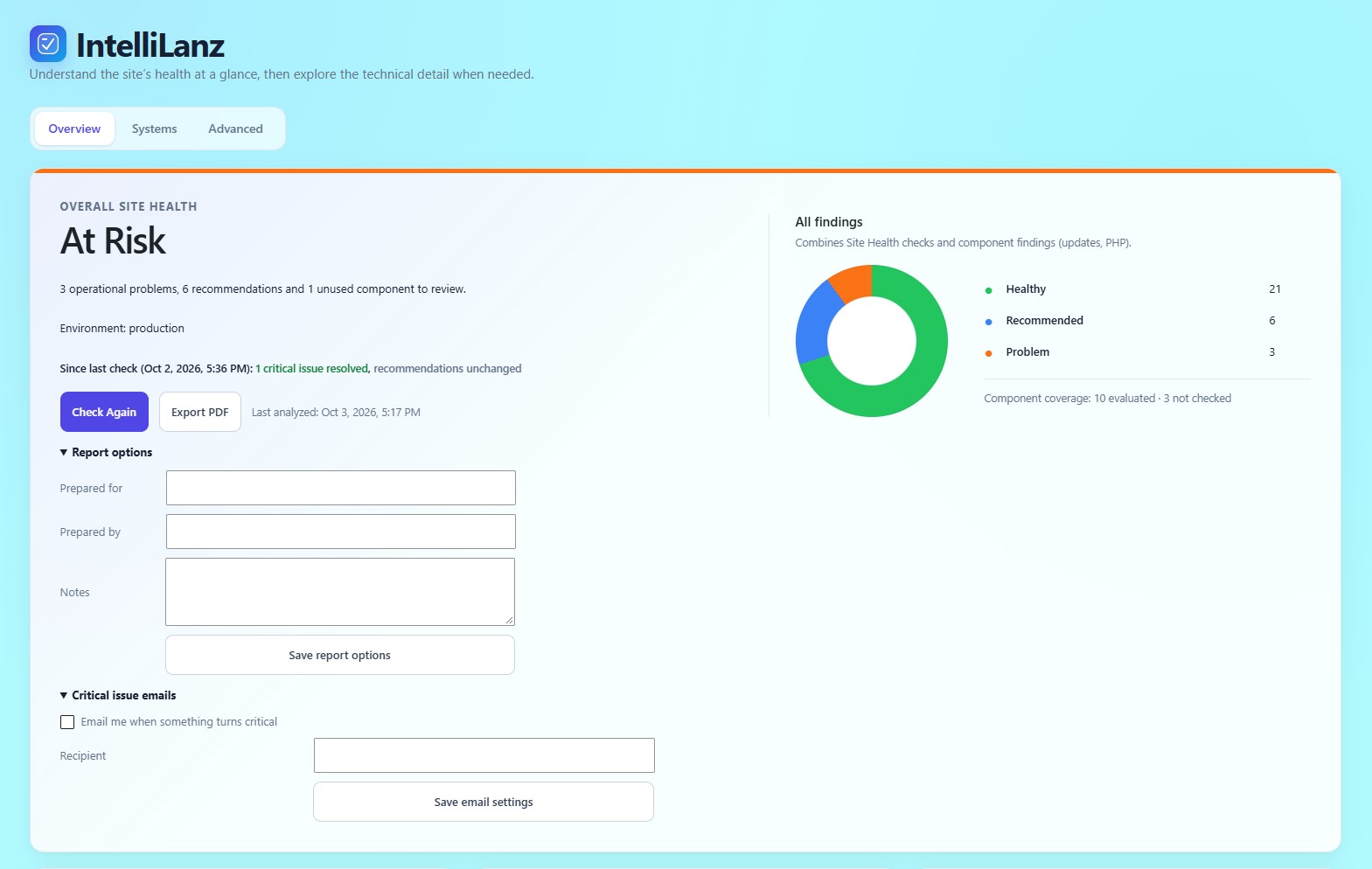
So I started building IntelliLanz as a WordPress site-health and inspection tool. The idea was to bring useful checks and observations together in one place so that the person responsible for a website has a clearer picture of its condition.
Of course, once you start building a tool like this, the temptation is to keep adding things. Another check. Another panel. Another clever way of displaying information. Developers are very good at turning a simple idea into a list of twenty-seven ideas.
But I don’t want IntelliLanz to become a dashboard that impresses developers while confusing everybody else. The point isn’t to show how much information a plugin can collect. The point is to help someone understand what deserves their attention.
That’s also why I think the difference between a tool and a useful tool matters. A long list of warnings isn’t automatically helpful. If everything looks urgent, nothing feels urgent. Clarity is part of the product.
I’m still learning where to draw that line. Which checks genuinely matter? What should be explained in plain English? How much detail is enough? Those questions are just as important as the code.
If IntelliLanz helps a site owner spot one issue earlier, ask a better question or avoid an unnecessary panic, then it’s doing the kind of work I built it for.
Because website problems don’t usually make appointments. It would be nice to see at least a few of them coming.
Check it out https://mazlanhalim.com/intellilanz